Description
Soil Moisture Sensor Module – Soil Humidity and Water Detection Sensor
The Soil Moisture Sensor Module is a practical electronic component designed to detect moisture conditions in soil. It is ideal for electronics enthusiasts, students, hobbyists, gardeners, and developers working on Arduino-based projects, smart irrigation systems, and automatic plant watering applications.
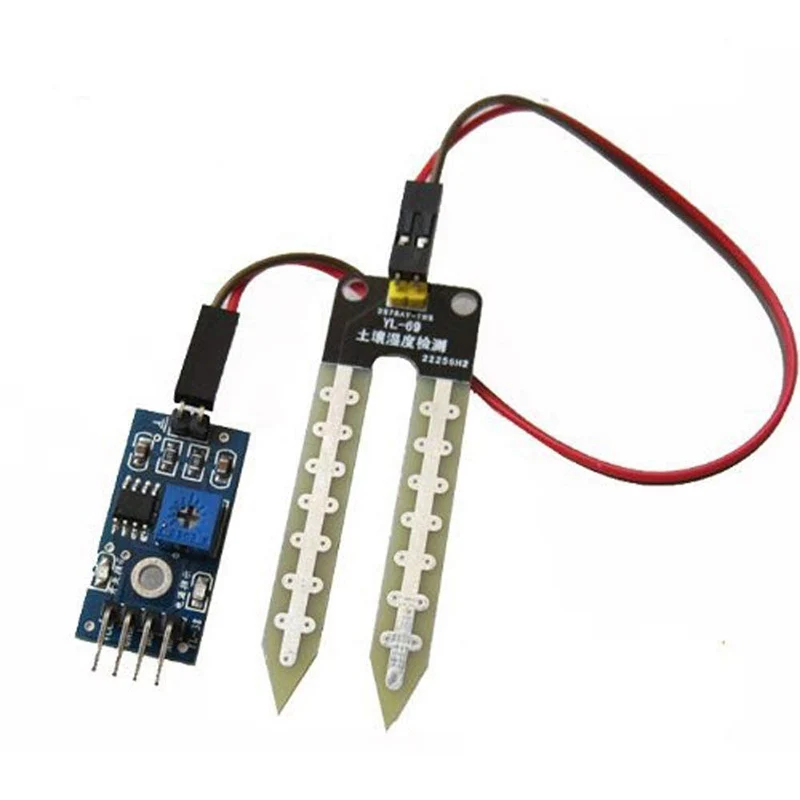
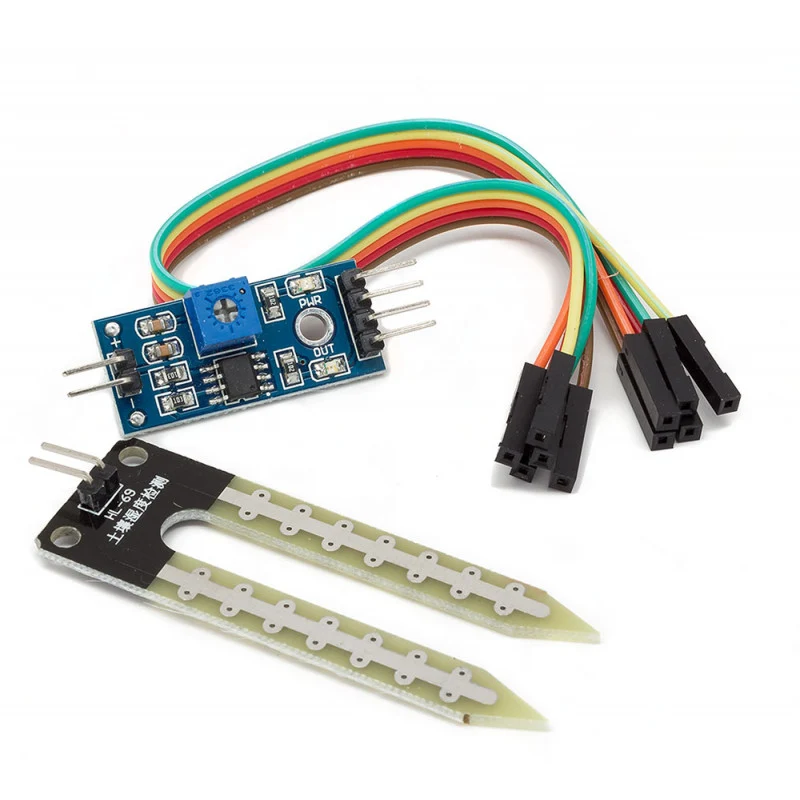
This sensor consists of a soil probe and an interface module that detects changes in electrical conductivity as the moisture content of the soil changes. The probe is inserted into the soil, while the interface board processes the sensor signal and provides an output for compatible electronic circuits.
Whether you are developing a smart gardening project, experimenting with environmental sensors, or building an automatic plant watering system, this soil moisture detection module offers a simple way to incorporate soil moisture sensing into your design.
Key Features of the Soil Moisture Sensor
- Soil Moisture Detection: Detects changes in soil moisture by measuring electrical conductivity between the probe’s sensing elements.
- Sensor Interface Board: Includes an electronic module for processing the probe signal.
- Adjustable Sensitivity: The onboard potentiometer allows threshold adjustment on compatible interface boards.
- Microcontroller Compatibility: Suitable for many Arduino and other compatible microcontroller projects, subject to voltage and signal requirements.
- Compact Design: Convenient for electronics experiments and DIY applications.
- Easy Integration: Can be connected to compatible circuits for moisture monitoring and control.
- Multiple Applications: Useful for gardening, agriculture demonstrations, irrigation prototypes, and educational projects.
How Does a Soil Moisture Sensor Work?
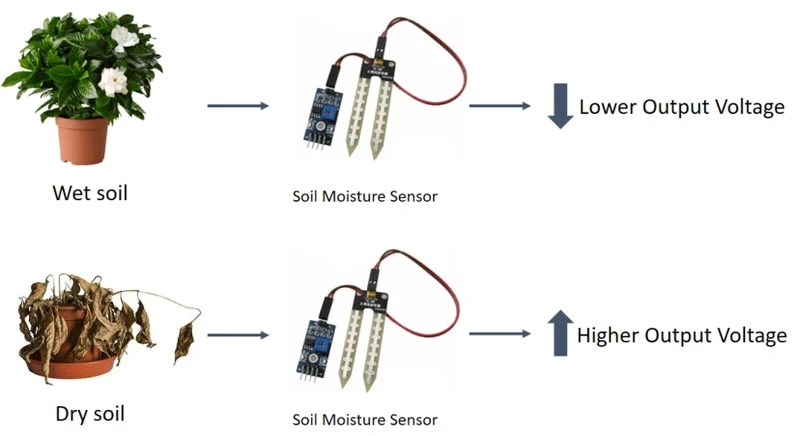
The probe contains conductive tracks that interact electrically with the surrounding soil. As the soil’s moisture content changes, its electrical conductivity generally changes as well. The interface module detects these changes and produces a corresponding electrical signal.
On versions with an analog output, the signal can be read by a compatible microcontroller to monitor relative changes in soil moisture. On versions with a digital output, an onboard comparator can provide a HIGH or LOW signal based on an adjustable threshold.
The readings depend on factors such as soil type, dissolved salts, probe condition, and temperature. This resistive sensor is best used for relative moisture detection rather than as a precision measurement instrument.
Typical Product Specifications
- Product name: Soil Moisture Sensor Module
- Sensor type: Resistive soil moisture sensor
- Sensing method: Electrical conductivity
- Construction: Soil probe with interface module
- Sensitivity adjustment: Onboard potentiometer, where provided
- Output: Analog and/or digital, depending on the interface board
- Applications: Soil moisture detection and monitoring
- Compatible platforms: Arduino and other compatible controllers, subject to electrical requirements
Confirm the exact operating voltage, pin configuration, dimensions, and output specifications for the supplied version before installation.
Applications of the Soil Moisture Sensor Module
1. Automatic Plant Watering System
Use the sensor as part of a controller-based watering project. When the soil reaches a configured moisture threshold, the controller can activate a compatible pump or valve through a suitable driver circuit.
2. Smart Gardening
Monitor changes in soil moisture in potted plants, indoor gardens, and small garden beds. The sensor can be connected to a microcontroller for displaying readings or triggering alerts.
3. Arduino Projects
Integrate the module into Arduino experiments to learn about sensor inputs, analog readings, digital signals, and conditional control.
4. Agriculture and Irrigation Prototypes
Use the sensor in educational or experimental irrigation systems to demonstrate moisture-based watering control. For outdoor or long-term agricultural use, consider a sensor designed for extended soil exposure.
5. Electronics Learning Projects
The module is suitable for students and hobbyists learning about environmental sensing, comparator circuits, sensor calibration, and microcontroller programming.
Benefits for DIY Electronics Enthusiasts
The Soil Moisture Sensor Module provides an accessible starting point for projects involving soil moisture detection. Its probe and interface board make it useful for demonstrating how a physical condition can be converted into an electrical signal.
By combining the module with a compatible microcontroller, display, buzzer, relay driver, or pump controller, you can develop a variety of monitoring and automation projects.
Installation and Usage Guidelines
- Insert the probe into the soil while keeping the interface electronics protected from moisture.
- Connect the module according to its pin labels and wiring documentation.
- Verify the operating voltage before applying power.
- Adjust the onboard potentiometer if your version provides an adjustable digital detection threshold.
- Test the sensor in different soil conditions and calibrate the readings for your application.
- Disconnect power before changing wiring.
- Avoid leaving the resistive probe continuously energized in wet soil, as this can accelerate corrosion.
- Keep the circuit board and electrical connections dry.
Important: This sensor detects soil moisture; it does not directly measure the amount of water available to a plant. For reliable long-term operation, inspect the probe regularly and consider a corrosion-resistant alternative when continuous monitoring is required.
Buy Soil Moisture Sensor Module Online from GETVOLT
The Soil Moisture Sensor Module is a useful component for smart gardening experiments, Arduino projects, automatic plant watering prototypes, and DIY electronics applications.
Explore this and other sensors, electronic modules, and DIY project components at GETVOLT.in to find suitable parts for your next electronics project.
Reviews
There are no reviews yet.