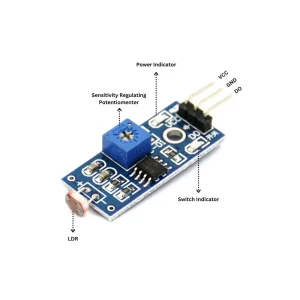
Description
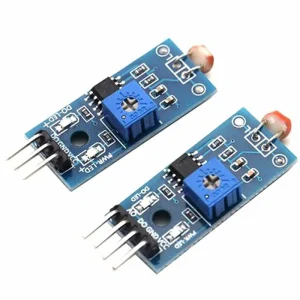 LDR Light Sensor Module – Photoresistor Light Detection Sensor
Discover a simple way to detect changes in surrounding light with the LDR Light Sensor Module, available at GETVOLT. This compact electronic module uses a Light Dependent Resistor (LDR), also known as a photoresistor, to respond to variations in light intensity.
As the amount of light falling on the LDR changes, its electrical resistance changes. The module’s onboard circuit can use this variation to determine whether the surrounding light level is above or below an adjustable threshold.
The LDR Light Sensor Module is suitable for Arduino projects, DIY electronics, robotics experiments, and automatic lighting systems. It is a practical component for students, hobbyists, makers, and electronics enthusiasts who want to explore light detection and sensor-based automation.
Key Features
- Light Intensity Detection: Detects changes in surrounding brightness using a photoresistor.
- Adjustable Sensitivity: The onboard potentiometer allows you to adjust the switching threshold on common module versions.
- Digital Signal Output: Many versions provide a digital HIGH or LOW output when the detected light crosses the configured threshold.
- Compact PCB Design: Easy to incorporate into many DIY electronics and robotics projects.
- Microcontroller Compatibility: Suitable for compatible Arduino boards and other control systems.
- Automatic Lighting Projects: Useful for experimenting with light-activated and darkness-activated circuits.
- Beginner-Friendly Component: Suitable for electronics learning, prototyping, and educational demonstrations.
Product Specifications
- Product name: LDR Light Sensor Module
- Sensor type: Light Dependent Resistor (LDR) / Photoresistor
- Detection principle: Resistance changes with light intensity
- Adjustment: Onboard potentiometer
- Output: Typically digital; analog output depends on the module version
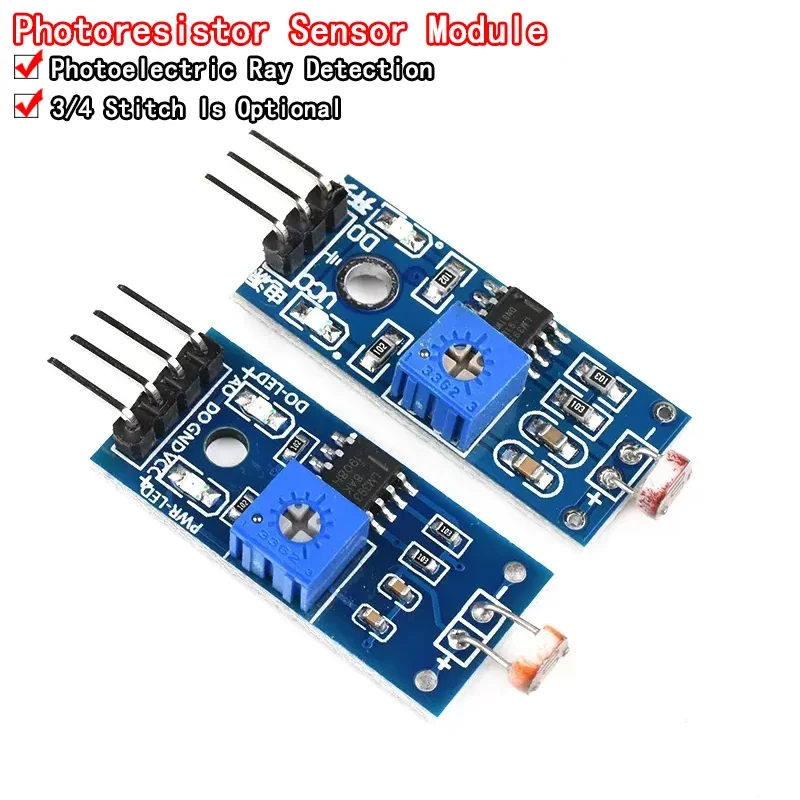
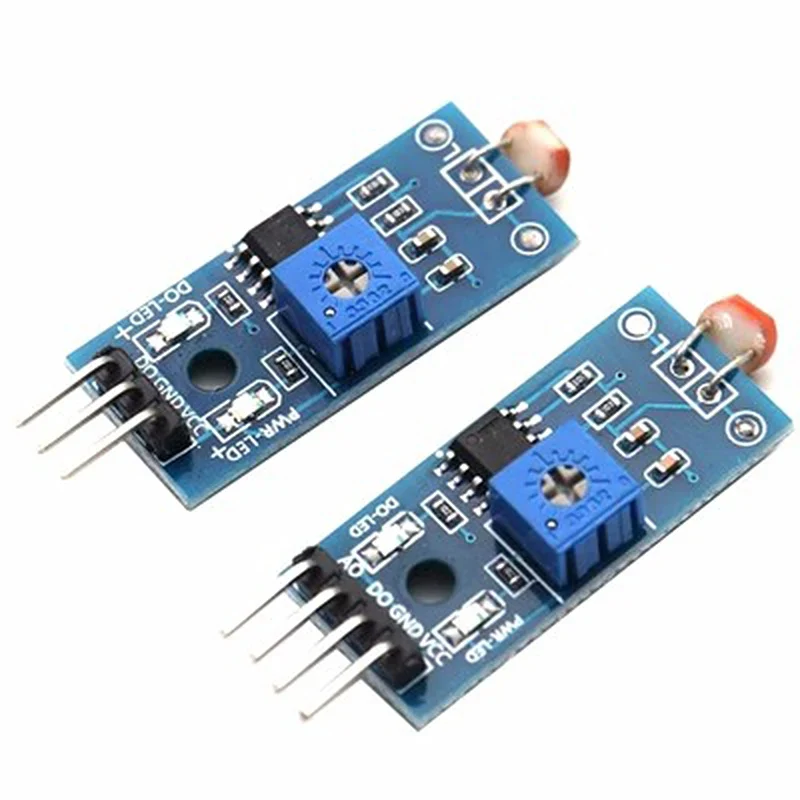
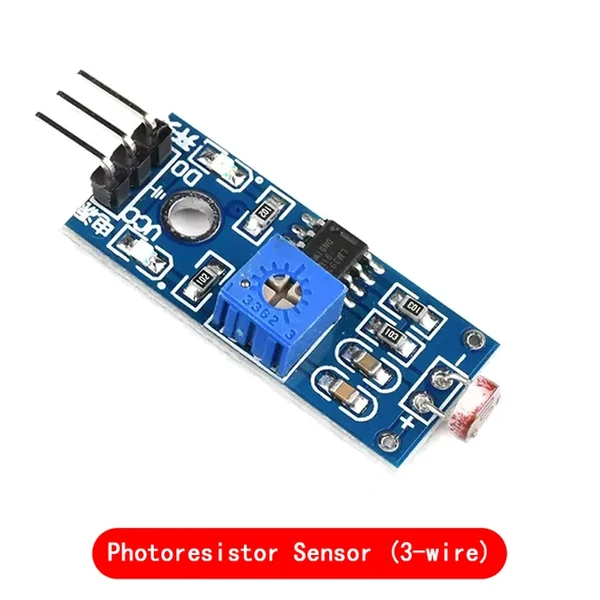
- Interface: Commonly 3-pin or 4-pin, depending on the board
- Operating voltage: Verify the specifications printed on the module or supplied by the seller
- Applications: Light detection, day/night sensing, robotics, Arduino, and DIY automation
Exact pin configuration, output type, and supply-voltage requirements can vary by module version.
How Does the LDR Light Sensor Work?
An LDR is a light-sensitive resistor whose resistance typically decreases as the light falling on its surface increases. In darker conditions, its resistance generally increases.
The sensor module uses this electrical change to produce a signal. On common comparator-based boards, the onboard circuit compares the sensor signal with an adjustable reference level. When the light level crosses the configured threshold, the digital output changes state.
This allows a connected microcontroller or control circuit to respond to changes in brightness without requiring a complicated sensor interface.
Applications of the LDR Light Sensor Module
The LDR Light Sensor Module can be used in many compatible electronics projects, including:
- Automatic night lights
- Daylight and darkness detection
- Arduino light-sensing projects
- Light-activated switching circuits
- DIY smart lighting systems
- Robotics and educational experiments
- Light-sensitive alarms and indicators
- Electronic science-fair projects
- Brightness-based automation prototypes
- General-purpose light detection experiments
Why Choose This LDR Sensor Module?
The LDR Light Sensor Module provides a convenient way to explore light-sensitive electronics. Its photoresistor detects variations in brightness, while the onboard adjustment and comparator on common versions make threshold-based detection straightforward.
Whether you are learning Arduino programming, building an automatic light, or experimenting with sensor-based control, this module is a useful addition to your electronics toolkit.
How it works
1. Module light conditions or light intensity reach the set threshold, DO port output high when the external ambient light intensity exceeds a set threshold, the module D0 output low;
2. Digital output D0 is directly connected to the MCU, and detect high or low TTL, thereby detecting ambient light intensity changes;
3. Digital output module DO can directly drive the relay module, which can be composed of a photoelectric switch.
Pin details
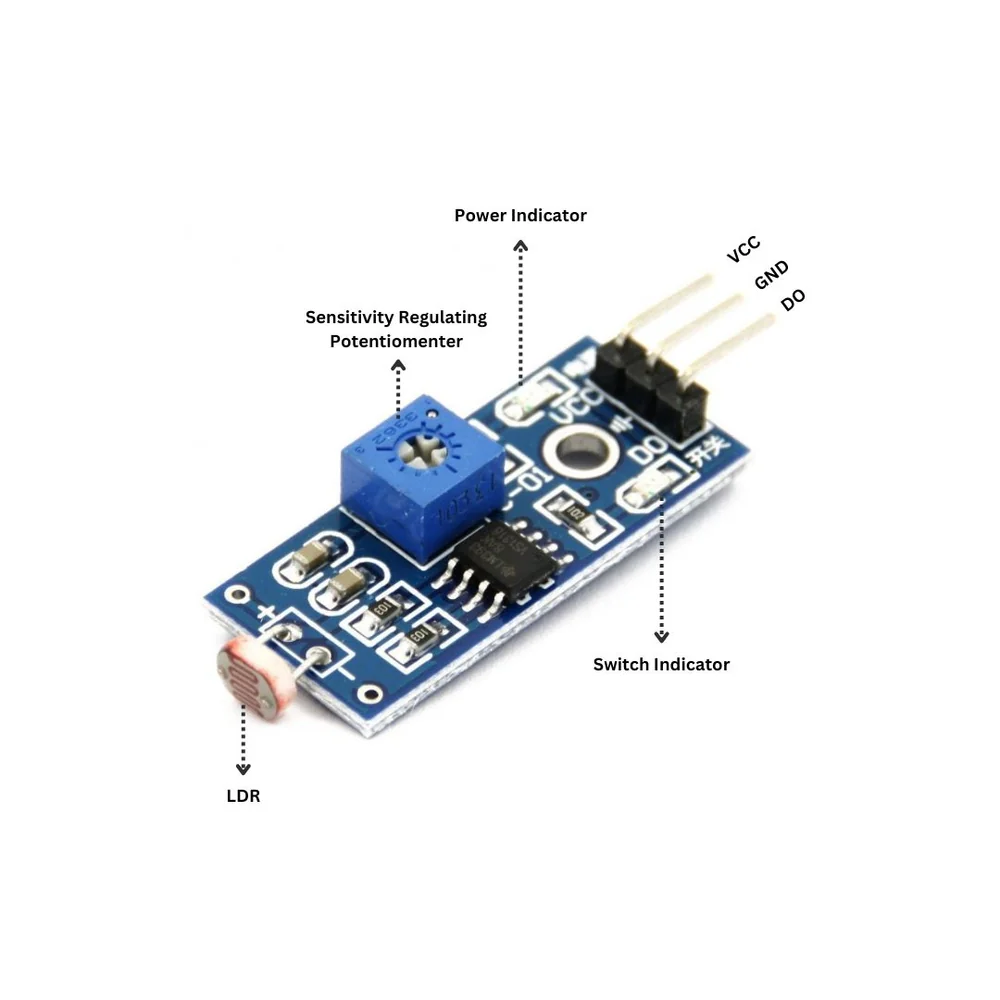
VCC ↔ 3.3V to 5V DC.
GND ↔ Ground.
DO ↔ Digital Output.
Features :
- LM393-based design.
- It can detect ambient brightness and light intensity.
- Adjustable sensitivity (via blue digital potentiometer adjustment).
- Output Digital – 0V to 5V, Adjustable trigger level from preset.
- LEDs indicating output and power.
Basic Connection Guide
Before connecting the module, identify the pin labels printed on your specific board.
- VCC: Connect to the specified positive supply voltage.
- GND: Connect to the circuit ground.
- DO: On modules with a digital output, connect to a compatible digital input.
- AO: If provided, connect the analog output to a compatible analog input.
Some versions expose only three pins, while others provide four. Always verify the board’s pinout and voltage compatibility before powering it. Adjust the onboard potentiometer gradually while testing the sensor under different lighting conditions.
Buy LDR Light Sensor Module from GETVOLT
Add light-detection capabilities to your next electronics project with the LDR Light Sensor Module. It is a practical component for Arduino experiments, automatic lighting prototypes, robotics, and DIY sensor applications.
Explore more electronic components, sensors, and DIY project accessories at GETVOLT and find the components you need for your next creation.

Amit –
Nice product 😁
I will buy more from getvolt
Best quality